
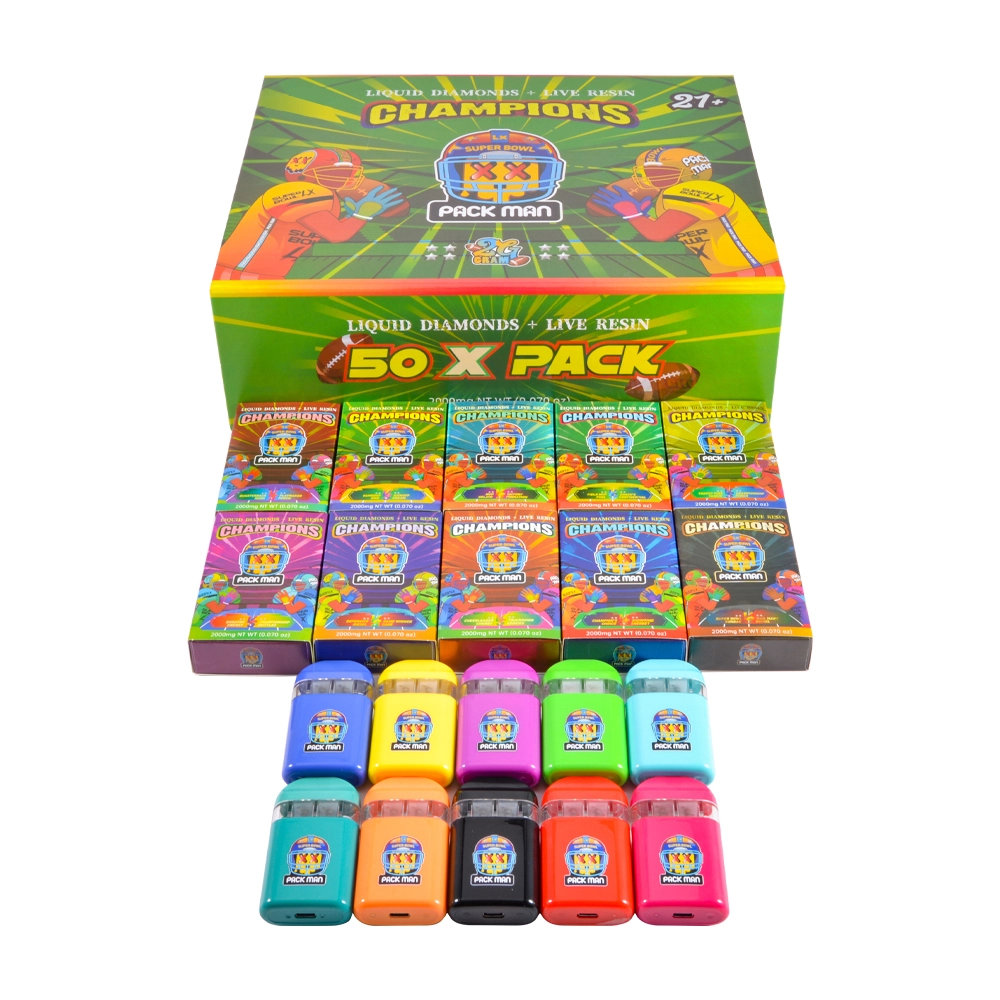
Once you move past first impressions, Packman & NFL 2G empty disposables become a practical question: does this collab chassis behave well enough—in the lab, on your line, and in transit—to justify a place in your hardware stack? Mid-funnel is where you start comparing, testing, and building a case for or against.
This article looks at Packman & NFL 2G as hardware to be evaluated. It outlines typical specs, where this shell realistically fits in a portfolio, and a QC playbook you can apply to incoming samples and pilot lots.
1. Typical Hardware Spec Profile for Packman & NFL 2G
Exact numbers will vary by supplier, but most Packman & NFL 2G shells follow a similar pattern. Group the spec into mechanical, electrical, and packaging.
Mechanical profile
-
Capacity class – approximately 2 grams of target formulation; internal volume should be known and documented.
-
Chamber layout – usually a single chamber, but some variants may support dual modes or separate zones; either way, geometry must support even wicking.
-
Intake system – multiple inlets sized for viscous fills, positioned to reduce dry pockets and flooding.
-
Mouthpiece & seals – snap-in or welded mouthpiece with primary and secondary seals around the chamber.
-
Shell geometry – distinctive Packman & NFL profile with flat faces for graphics and warnings.
Electrical profile
-
Battery – compact lithium cell tuned for the expected sessions at the intended power level.
-
Protections – basic over-current, short-circuit, and under-voltage cutoffs; some variants may support over-temperature monitoring in the control circuit.
-
Activation logic – draw-activated is common; certain models may add a button or preheat function.
-
Coil resistance – a defined resistance band and tolerance that must be matched to your oil type and target power.
Packaging profile
-
Unit and inner – protective pockets or trays that guard mouthpieces and shell finish during transport.
-
Cartons – board and structure designed to survive normal parcel handling and storage.
-
Traceability – batch and revision codes visible at carton level and, ideally, on individual devices.
These details are what your engineering and QC teams will care about once the logo novelty wears off.
2. Where Packman & NFL 2G Makes Sense in B2B Portfolios
The Packman & NFL chassis is not a generic commodity shell. It tends to work best in specific B2B scenarios.
Use case 1: Premium seasonal launch
You want a high-impact, limited-window product tied to football season or specific events. Packman & NFL 2G provides:
-
A story you can build around schedules, games, and partnerships.
-
A visual anchor that signals “special edition” without changing the internal spec.
-
A chassis capable of supporting higher perceived value at wholesale and retail.
Use case 2: Hero SKUs for sports-centric markets
In regions where sports identity drives buying behavior, a Packman & NFL-branded shell can become your hero chassis for key accounts or fan-heavy zones, with your other hardware forming the supporting lineup.
Use case 3: Controlled collaborations
If you work with partners (retail chains, entertainment brands, or content creators) close to sports culture, this chassis becomes a ready-made surface for joint projects, while the internal engineering remains stable.
In all three use cases, the collab art makes sense only if the hardware behaves like a well-engineered 2G device.
3. QC Playbook for Packman & NFL 2G Samples
When samples arrive, you need a consistent way to judge them. A basic playbook might look like this.
Step 1: Visual and dimensional checks
-
Inspect print quality, colors, and alignment of Packman & NFL graphics.
-
Check for scuffs, bubbles, or incomplete coating.
-
Measure length, width, thickness, and mouthpiece dimensions against the spec sheet; note variability.
Step 2: Functional checks (unfilled)
-
Test activation: each sampled unit should respond to a draw or button press as designed.
-
Confirm LED or screen behavior follows the expected pattern (activation, cut-off, low battery).
-
Measure coil resistance on a subset of units and confirm it lies within the specified range.
Step 3: Seal and structure checks
-
Inspect the mouthpiece connection and visible seals for gaps or misalignment.
-
Perform simple vacuum or pressure tests on unfilled units, if your lab supports this, to flag gross leaks.
-
Place samples through a moderate thermal shift (for example, room temperature to warm and back) and recheck seals.
These steps tell you whether the shell is at least mechanically and electrically coherent before you add your own liquid.
4. Designing a Pilot With Your Fill
A proper pilot uses your own oil or liquid, not just test fluids.
Key elements:
-
Set fill and soak parameters
-
Define fill level, viscosity range, and soak time based on your formulation.
-
Document the exact conditions for repeatable tests.
-
-
Monitor leak and condensation
-
Store filled pilot devices in realistic packaging.
-
Inspect after defined intervals for chamber leaks, mouthpiece sweating, and condensation patterns.
-
-
Measure draw and vapor delivery
-
Use either instrumentation or a trained panel to evaluate draw resistance and output consistency across units.
-
Note any correlation between performance and particular batches.
-
-
Simulate transit
-
Subject a subset of packaged pilot units to shaking, stacking, and drop scenarios that mimic real routes.
-
Re-inspect for mechanical damage and seal failures.
-
You’re not trying to prove perfection; you’re trying to see whether Packman & NFL 2G behaves predictably on your line and in your logistics reality.
5. Questions to Take Back to the Supplier
After running the playbook, collect questions and only then talk to your supplier:
-
Can they provide more precise chamber volume data in ml, with tolerances?
-
Do they have battery safety and transport testing documentation for this exact variant?
-
How do they handle design changes, especially around coil, plastics, or seals?
-
Can they hold color, print, and finish variation inside defined limits over multiple lots?
The answers will tell you whether this is a one-off collab chassis or a hardware platform you can actually standardize around.
Closing: From Branded Shell to Measured Component
At mid-funnel, the Packman & NFL 2G empty disposable moves from being a cool branded shell to a tested component with measurable behavior. Once you have real data on leaks, draw, runtime, and finish—and real answers on documentation and change control—you can put it in the right place in your portfolio. Whether that is a premium seasonal format, a long-term hero device, or a carefully limited collaboration chassis depends on how well the hardware supports the promises you want your brand to make.
If you want more empty vape wholesale,Please go through the following pages: packman vape pen , 2 gram disposable vape pen|.packman & NFL 2g, packman nfl vapes 2ml US

0 Comments