
Purpose & Scope
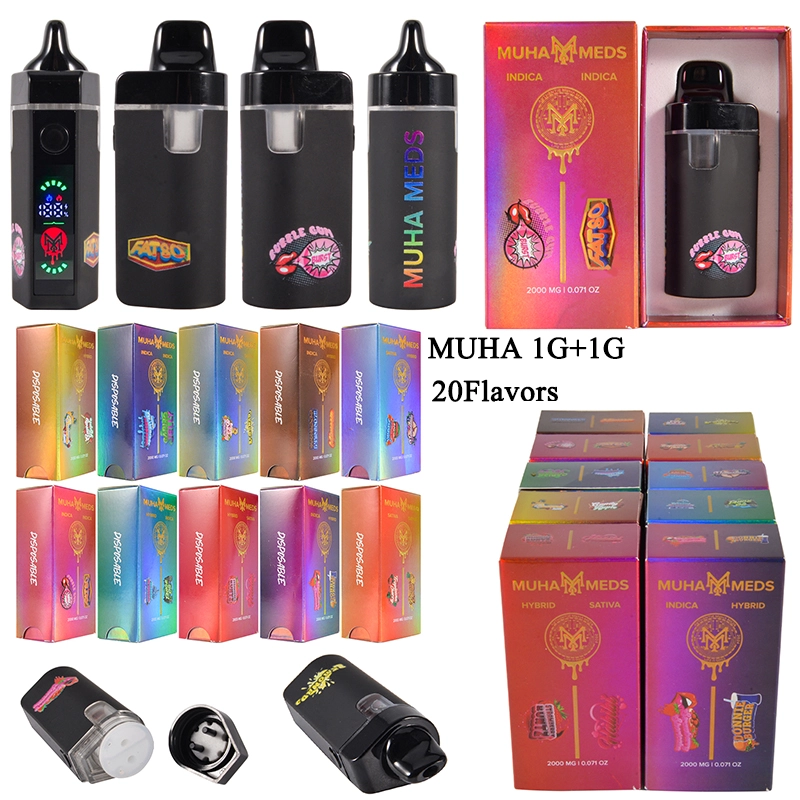
This mid-funnel brief shows how a Muha-style 2 g empty disposable actually moves air and oil—from intake ports through the ceramic and out the chimney—and what to verify so the device starts clean, finishes the tank, and ships without leaks.
Intake Map (From Reservoir to Mouthpiece)
A) Reservoir: food-grade PCTG with a clearly marked safe-fill line and headspace tolerance to prevent expansion weep.
B) Intake Ports: multiple inlets per side sized for viscous fills (effective area equivalent to ~4×1.5–1.6 mm or documented equivalent). Port height above the tank floor controls flood vs. starvation.
C) Capillary Channel: short, smooth, and symmetrical to reduce back-pressure and speed saturation after soak/cure.
D) Ceramic Core: advanced, porous ceramic with a tight resistance window (~1.0 Ω nominal) for even thermal distribution.
E) Manifold/Chimney: laminar outlet path sized for a medium, smooth draw; gurgle mitigation via baffles.
F) Seal Stack: O-rings + ultrasonic welds + controlled mouthpiece torque; this stack sets your leak/DOA rate in real freight.
Ports & Airflow: What to Measure
-
Effective Intake Area: confirm count × diameter; too small ⇒ hard draw/scorch, too large ⇒ flood/weep.
-
Port Height & Channel Length: higher ports and shorter channels help post-fill stability and faster first puffs.
-
Draw Parity: target consistent draw across lots; audible turbulence often signals channeling or misaligned baffles.
-
First-10-Puff Success: a fast indicator that your intake map matches your viscosity band.
Pilot tip: log first-minute performance after the vendor’s soak/cure window; don’t judge immediately off the fill needle.
Coil & Output Curve: Even Heat Wins
-
Ceramic at ~1.0 Ω (± tolerance) spreads heat uniformly to avoid hot spots and late-tank scorch.
-
Gentle Preheat (if present): brief, low-energy pulse clears condensation without cooking the formula.
-
Thermal Stability: verify the device maintains flavor near empty; aggressive voltage curves mask runtime but raise returns.
USB-C Runtime: Finish the Tank, Not Just the Shelf Demo
-
Cell Sizing: 2 g class devices typically pair a right-sized lithium cell with protections for short-circuit/over-charge/over-discharge.
-
Charging Behavior: stable USB-C port retention; reliable handshakes; realistic time-to-full at standard 5 V inputs.
-
Runtime KPI: ≤1 top-up (median) to reach near-empty under typical use; early battery death drives exchanges.
Seal Strategy: Leak Discipline Is Engineered, Not Promised
-
Gasket Compression Window: repeatable compression = predictable headspace control.
-
Ultrasonic Weld Lines: continuous, clean seams survive thermal swing + vibration.
-
Mouthpiece Torque: set and verify a narrow, repeatable torque band; many “mystery leaks” start here.
Acceptance KPIs (One-Week Pilot, Go/No-Go)
-
Post-transit leak rate: ≤ 1.0 / 100 after heat↔cold cycling + vibration/drop
-
First-10-puff success: ≥ 95% without preheat tricks
-
Runtime to near-empty: ≤ 1 charge top-up (median)
-
Clog-resolution incidence (week one): ≤ 2%
-
DOA / early failure: ≤ 0.5%
Documentation Packet (Audit-Speed Onboarding)
-
Exploded views & dimensions: intake count/diameter/placement, resistance window, torque spec
-
Filling SOP: temperature, safe-fill, headspace, soak/cure window
-
Device/battery safety statement + lithium transport test summary for the exact cell/pack
-
Assembled-unit materials/heavy-metal results for oil-contact parts
-
QC regimen: pressure/air-tightness on finished assemblies; thermal/vibration/drop; AQLs with RMA/CAPA
-
Packaging map: reserved zones for warnings, batch/lot IDs, serialization
Bottom Line
If the intake map is right and the dossier is real, a Muha-style 2 g empty pod will start clean, stay clean, and finish the tank with low service load. Pilot with your oil, lock the spec, and scale the backbone that wins on leak discipline, runtime, and first-puff quality.
What Is xmas Packman 2G Empty Disposable? Form Factor & Use Cases
(Empty hardware only—no oil, no cannabinoids. For licensed B2B buyers planning seasonal drops.)
Why a Holiday Edition?
Q4 limited skins lift conversion—if they ride on a proven chassis. “xmas Packman 2G” describes a single-chamber, 2 g bar-style empty disposable with seasonal artwork. The goal is not decoration; it’s repeatable performance under winter logistics with compliant packaging.
Form Factor (The Backbone Under the Skin)
-
Capacity: true 2.0 mL class reservoir with safe-fill line and headspace guidance.
-
Heating: advanced ceramic core with a narrow resistance window (~1.0 Ω nominal).
-
Airflow: balanced, medium draw; optional gentle preheat to clear condensation.
-
Power: USB-C rechargeable lithium cell sized to finish the tank; protections for short-circuit/over-/under-charge.
-
Seal Stack: O-rings + clean welds + controlled mouthpiece torque to minimize weep in cold↔hot shipping.
-
Chassis: large flat panels for warnings, batch/lot IDs, and serialization—do not let snowflakes crowd compliance text.
(Note: This guide covers the standard single-chamber Packman 2 g. Dual-flavor “switch” models have separate selection logic and isolation tests.)
Primary Use Cases for Retail Programs
-
Holiday Limiteds: seasonal art on the same backbone; faster approvals and fewer surprises.
-
Collab SKUs: co-brand cosmetics while preserving your warnings/serialization map.
-
Flavor-of-the-Month: rotating sleeves on identical hardware keep training stable.
-
Geo Editions: localized art/compliance blocks without changing molds/BOM.
-
Gift Bundles: consistent footprint and finish tolerances simplify planograms.
Spec Snapshot (Targets to Verify in Pilot)
-
Capacity: 2.0 mL, safe-fill visible
-
Coil: ceramic, ~1.0 Ω nominal
-
Intake geometry: multi-port inlets matched to viscous fills
-
Airflow: smooth, medium; low turbulence
-
Runtime: ≤ 1 top-up to near-empty (median)
-
Port retention: USB-C socket passes insertion/rock testing
-
Finish: abrasion-resistant coatings; color tolerance documented for reorders
-
Traceability: carton + inner batch/lot IDs; optional discreet device marks
Artwork & Packaging Map (Where Teams Slip)
-
Preserve minimum font sizes and contrast for warnings and batch codes.
-
Verify adhesion/colorfastness of metallic/foil inks after thermal cycling.
-
Keep serialization and barcodes scannable under store lighting.
-
Assign unique style codes/SKUs to prevent holiday mis-picks.
-
Photograph production cartons before shipment as visual QA references.
Pilot Plan (One Week, Five KPIs)
-
Post-transit leak rate after cold↔heat + vibration/drop
-
First-10-puff success from first activation
-
Runtime to near-empty with standard 5 V recharges
-
Clog-resolution incidence within week one
-
DOA/early failure at receiving
Approve only if xmas Packman meets or beats your baseline on all five.
Documentation & Compliance (Holiday-Ready, Audit-Fast)
-
Exploded views & dimensions (intakes, resistance, torque)
-
Fill/headspace/soak-cure SOP
-
Device/battery safety statement + lithium transport test summary for the exact cell/pack
-
Assembled-unit materials/heavy-metal results for oil-contact parts
-
QC regimen with AQLs, pressure/air-tightness, thermal/vibration/drop
-
Change control: locked molds/BOM; golden samples retained; EOL notice for seasonal finishes
Red Flags (Walk Away Quickly)
-
Prefilled pitches or fuzzy brand authorization
-
Generic PDFs not tied to the exact SKU and recent production
-
Resistance/finish/intake drift between samples and pilot lot
-
No pressure-test method, no AQL numbers, vague RMA terms
-
Holiday art that crowds warnings or hides serialization zones
Final Take
A strong xmas Packman 2 g program is 90% backbone, 10% snowflakes. Choose the chassis that proves intake balance, ceramic stability, runtime, and leak discipline under your lanes, then let seasonal cosmetics do their job—lifting Q4 sell-through without lifting your return rate.
If you wanna know more details, pls go to these pages: wholesale muha meds, custom muha meds disposable, muha meds disposables 2 gram.


0 Comments