
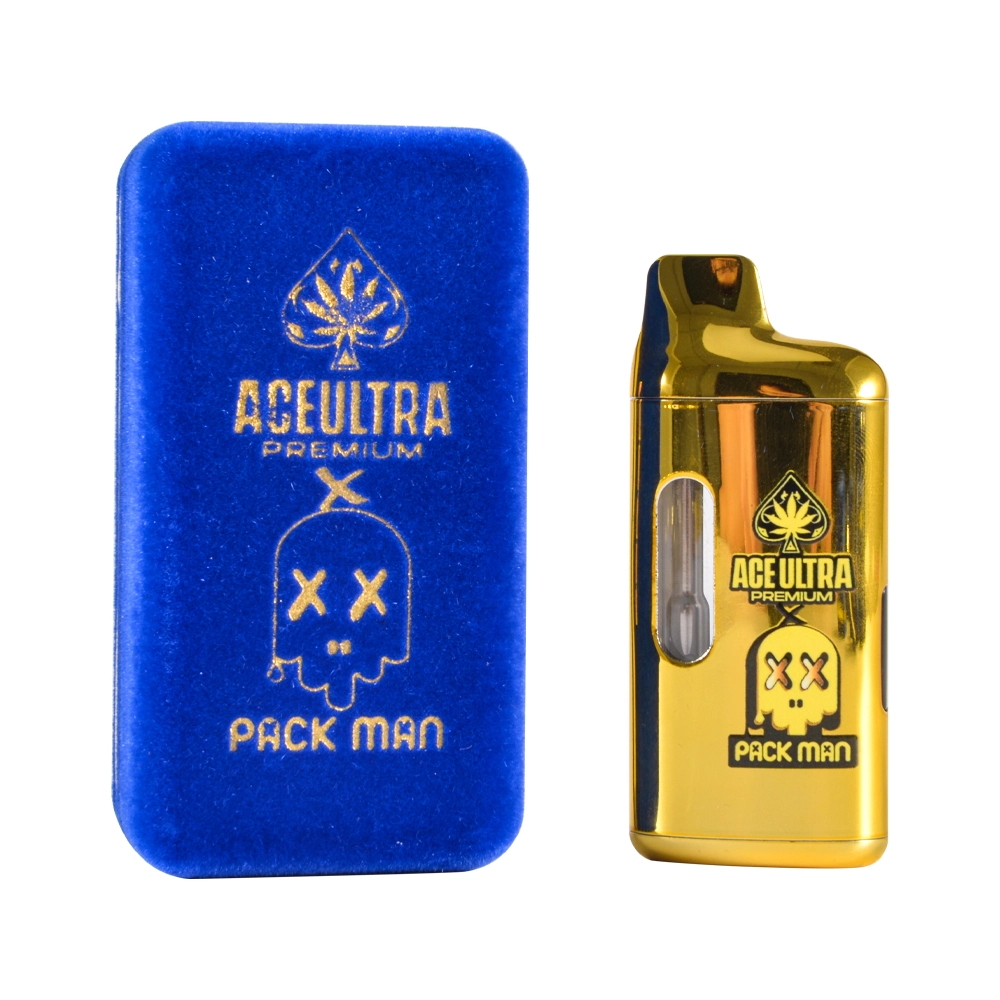
Who this is for (MOFU): B2B buyers and brand owners who’ve finished basic research and are choosing a supplier for empty ace packman 1000mg (1-gram capacity) disposable shells. Objective: de-risk samples, confirm compliance, and scale a low-RMA, high-repeat SKU.
One-Sentence Takeaway (for busy buyers)
To turn empty ace packman 1000mg into a high-margin, low-return hero SKU, pick suppliers who can prove device safety and battery transport compliance (UL 8139, UN 38.3, IATA/PHMSA), validate heater–oil compatibility with real fill tests, price with a landed-cost model, lock RMA/replacement terms in the PO, and deploy serialization + receiving SOP to keep counterfeits and defects out.
Why the 1000mg (1 g) “Empty” Form Factor?
-
Broad compatibility: 1 g is the mainstream capacity; it accommodates a range of viscosities (distillate, terpene-rich, live resin–style extracts), helping balance freshness and turns.
-
Mature architecture: Proven modules typically pair microporous ceramic heating and PCTG clear tanks—easier to dial in consistent flavor and draw.
-
Cost sweet spot: Component and fill costs are balanced at 1 g, letting you differentiate with flavor lines while protecting margin.
Spec Checklist (use this to compare suppliers on one page)
-
Atomizer/heater: Microporous ceramic or ceramic core; check pore size and power match to avoid overheat (harshness) or underheat (condensate/spit-back).
-
Power/coil resistance: Request the heating curve or minimum viable power for your target oil window (typically effective across a 2–6 V equivalent).
-
Battery: For 1 g, 280–400 mAh is common; require overcharge/short/overcurrent protections and basic consistency data.
-
Charging: USB-C preferred with reverse-polarity and over-temp protections.
-
Airpath & leak control: Dual/triple sealing, plus 24–48 h inverted rest leak-rate data.
-
Materials & wetted parts: PCTG / 316 stainless on contact surfaces; ask for heavy-metals and VOC screens.
-
Finish & durability: Coatings (rubber paint, soft-touch, plating) should pass sweat and alcohol-wipe rub tests.
-
Customization: Tooling/printing/laser codes; carton/inner box options; serialization/traceability readiness.
Pro tip: Request a sample parameter sheet + small-batch fill test report instead of only subjective “smooth taste” claims.
Compliance & Safety (what to demand before sampling)
-
UL 8139 (device safety evaluation): Covers electrical, heating, battery, and charging systems of vaping devices; it does not evaluate oils.
-
UN 38.3 (lithium battery Test Summary): Design-level tests must be passed and a Test Summary provided; carriers frequently request it.
-
IATA (air) / PHMSA (U.S. domestic & multimodal): Follow current lithium-battery shipping guidance, including marking/labeling and state-of-charge limits; air and ground rules differ.
-
IEC 62133-2: Useful supplemental reference for rechargeable battery safety.
-
State packaging/CRP (if you ever sell prefilled): Child-resistant, tamper-evident, correct symbols/warnings, age statements.
-
Lab dossiers: Heavy metals/residuals, materials contact, hygiene (factory GMP/cleanliness), and packaging integrity (e.g., ISTA 3A drop/stack).
Contract language: Make a Compliance Pack (certs/test summaries/label art/shipping SOP) a pre-delivery condition in the PO.
Landed Cost = your real price (and your negotiation lever)
Formula
Landed $/Unit = (Product Price + Freight + Compliance/Admin + Insurance + Taxes + Other Fees − Credits/Discounts) ÷ Units
Illustrative comparison
| Qty | Product $/u | Freight $/u | Compliance $/u | Insurance $/u | Taxes $/u | Credits $/u | Landed $/u |
|---|---|---|---|---|---|---|---|
| 10 | 6.20 | 0.80 | 0.25 | 0.05 | 0.20 | 0.00 | 7.50 |
| 200 | 5.10 | 0.20 | 0.18 | 0.03 | 0.18 | −0.10 | 5.59 |
| 1,000 | 4.60 | 0.06 | 0.12 | 0.02 | 0.16 | −0.20 | 4.76 |
What moves the needle: freight caps/thresholds, spreading one-time compliance admin over volume, and tiered discounts/rebates. Beware: a high RMA replacement rate erases savings fast—price in a defect allowance.
Sampling & Pilot Run (contain risk at 200–500 units)
-
Two-viscosity fill: Same device, two viscosities (e.g., higher-terp, standard) to map condensate/spit-back and flavor stability.
-
Rest & thermal cycles: Inverted rest plus hot/cold cycles (e.g., 0–40 °C) to observe seepage and draw consistency.
-
Charge/discharge safety: Fast-charge and over-discharge scenarios; record protection triggers and behavior.
-
Blind panel: Controlled tasting rubric (layering, smoothness, throat hit, aftertaste) with small trained panel.
-
Receiving SOP draft: On arrival, scan serialization/QR (if present), take photos, and log variances immediately.
-
After-sales terms: In the PO, define defect criteria + replacement allowance + response window (e.g., DOA/7-day swap).
Procurement & Customization Strategy (for empty ace packman 1000mg)
-
MOQ & tiers: Negotiate 100/200/1000 steps; confirm whether mixed colors/flavors count toward the same tier and where free-freight triggers sit.
-
Exterior differentiation: Soft-touch, matte metal, or two-tone shells; place brand mark + anti-counterfeit code in a visible “golden triangle” on the face.
-
Version control: Require ECN (engineering change notice) for BOM/firmware/heater changes—no silent substitutions.
-
Traceability: Per-unit serials with mapping from master carton → inner box → unit.
-
Shipping documentation: Ship under UN 38.3 + current IATA/PHMSA; prep carrier-accepted declarations for the installed cell.
Risk & RMA Minimization (write “returns cost” into your plan)
-
Process stability: Lock heater and wick lots to reduce flavor drift.
-
Oil-path redundancy: O-rings + structural adhesive + snap-fit; one extra barrier often prevents a return.
-
Storage & age: Store upright, cool, and dark; enforce FIFO and log temp/humidity.
-
User guidance: Simple charging and use tips for storefront teams cut avoidable returns.
Supplier Scorecard (copy/paste and grade)
| Dimension | Weight | Vendor A | Vendor B | Vendor C |
|---|---|---|---|---|
| Compliance pack completeness (UL 8139 / UN 38.3 / IATA/PHMSA / materials & metals) | 25% | |||
| Heater & flavor stability (sample data + blind panel) | 20% | |||
| Price & tiering (incl. freight caps/rebates) | 20% | |||
| Lead time & build consistency (BOM/ECN control) | 15% | |||
| RMA/Replacement terms & response speed | 10% | |||
| Anti-counterfeit & traceability (serialization/QR/lot map) | 10% | |||
| Total | 100% |
Receiving (Intake) SOP — close the loop at the dock
-
Count master/inner/cartons and note damage.
-
Inspect exterior finish and seals.
-
Charge/activate/draw-test a small sample; log anomalies.
-
Match serials/lot IDs to packing list and quality docs.
-
Photograph everything; isolate suspect units; issue a corrective ticket to the supplier the same day.
-
Store upright; label arrival date + shelf-life threshold.
Closing Actions
-
Make UL 8139 / UN 38.3 / IATA/PHMSA documentation pre-delivery conditions of your PO.
-
Prove heater–oil fit with samples + pilot run before committing volume.
-
Price with Landed Cost and codify RMA/replacement terms.
-
Turn on serialization and a real receiving SOP from day one.
-
Lock one or two interchangeable empty ace packman 1000mg platforms so supply security and cost advantage coexist.
Follow this playbook and you’ll hit the MOFU sweet spot: look good, draw smooth, pass audits, protect margin—with fewer surprises after the pallet arrives.
If u wanna know more details, pls go to these pages : ace pac man in bulk, ace packman dispo in bulk, Ace ultra packman 1g wholesale.





0 Comments