

Line up a tray of ACE PACKMAN-style empty disposables next to a tray of slim, rounded bars and you can feel the design philosophy clash. One is wide-bodied, boxy, and built for presence; the other is sleek, pocket-friendly, and discreet. For a B2B buyer working on empty pod / empty disposable hardware only, those visual differences hide a deeper question: how do these shapes change intake behavior and runtime performance?
This article compares two form-factor archetypes from a hardware point of view only—no oil, no THC, no nicotine—so you can decide which chassis better supports your own brand, white label, or wholesale program.
Two Hardware Archetypes in One Portfolio
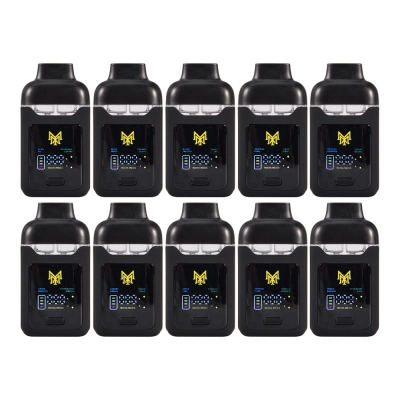
ACE PACKMAN-Style Chassis
Think of ACE PACKMAN as the “wide-body workhorse”:
-
Thicker body with a larger internal cavity.
-
Space for more battery capacity, a larger reservoir, or additional electronics.
-
Side or front air inlets that can be larger and more numerous.
-
Big flat faces for bolder branding and large labels.
This format is naturally suited to high-visibility programs where shelf impact and long perceived runtime matter just as much as subtlety.
Rounded Bar Devices
Rounded bars are the “minimalist commuters” of the disposable world:
-
Slender, rounded body that feels like a pen or slim bar.
-
Typically smaller battery and reservoir, optimized for portability.
-
Air inlets often integrated into the lower sidewalls or base.
-
Branding area is narrower but can still be clean and premium.
This style favors discretion, pocketability, and cost efficiency.
Intake: How Shape Drives Airflow and Feed
Although both devices are empty hardware, the way they handle air and intake is fundamentally influenced by shape.
Inlet Area and Positioning
-
ACE PACKMAN-style devices can host larger or multiple air inlets, because the wide body leaves room for channels, filters, and baffles. This supports softer draw at similar coil power and gives more options for fine-tuning restrictive vs airy profiles.
-
Rounded bars have less wall area and shorter internal pathways, which often leads to smaller inlets and more compact air routing. Done well, this produces a tight, cigarette-like draw; done poorly, it becomes uncomfortably restricted or noisy.
For B2B buyers, the question is: what draw profile is your market expecting, and does the chosen chassis give the engineer enough geometry to hit it?
Intake Stability and Tolerance to Variance
In production, small differences in hole size or alignment can change the draw noticeably:
-
In wide ACE PACKMAN-type bodies, air paths can be more forgiving because there is room to shape longer channels that smooth out small variations.
-
In slim rounded bars, even a fraction of a millimeter on a side inlet can create a unit that feels tight versus one that feels acceptable.
That means rounded bars demand tighter QC around drilling, molding, or punching of inlets; ACE PACKMAN-style devices give more room to design around variation.
Runtime: Battery, Coil, and Energy Use
Even as empty hardware, you must plan how battery and heater design will interact with your form factor.
Battery Capacity and Form Factor
-
The wider ACE PACKMAN chassis can usually carry a larger prismatic or pouch cell. That translates into longer runtime at the same power level or the ability to run slightly higher power profiles without sacrificing total use time.
-
Rounded bars are constrained by their slender profile, often using smaller cells. Runtime is adequate for lighter usage but may be stressed in “heavy user” markets or with power-hungry coils.
If your project promises “all-day use” or extended runtimes, ACE PACKMAN-style shells are naturally better candidates.
Coil Power, Thermal Management, and Comfort
-
With more internal volume, ACE PACKMAN bodies can dissipate heat more easily and can host heavier, more robust heating assemblies. That can support thicker liquids or more demanding use without hot spots at the shell.
-
Rounded bars have less mass and less distance between heater and exterior. If coil power is not tuned carefully, the device can feel warm in the hand or at the mouthpiece under intensive use.
For B2B hardware buyers, this means rounded bars require stricter thermal tuning, while ACE PACKMAN formats offer more flexibility for coil options and preheat or boost modes if you use them.
QC and Design Control by Form Factor
Whatever form you choose, you must translate these differences into your spec and QC plan.
Critical-to-Quality (CTQ) Items for ACE PACKMAN
For a wide-body chassis, typical CTQs include:
-
Air inlet dimensions and alignment.
-
Battery cavity dimensions and restraint features.
-
Wall thickness and flatness on branding faces (to avoid warping labels).
-
Internal channel alignment to avoid whistling or turbulence.
Sampling should focus heavily on draw feel, seal integrity, and cosmetic flatness of the large panels.
CTQs for Rounded Bars
Rounded bars have their own CTQs:
-
Inlet hole size and position, often more critical than in wide devices.
-
Shell alignment and seam straightness (small shells show defects easily).
-
Mouthpiece ergonomics and fit tolerance – any small mismatch is noticeable.
-
Battery compartment fit in a slender profile, to avoid rattle or stress points.
Here, sampling often centers on uniform draw, seam visibility, and any “hot spots” where thin walls overlay the heater.
Choosing the Right Chassis for Your B2B Program
There is no single “best” shape; the right answer is a match between user expectations, regulatory context, and brand story.
-
Pick ACE PACKMAN-style hardware if you need:
-
Long perceived runtime or heavier use per unit.
-
More room for dual-chamber, preheat, or more complex electronics.
-
Big canvas for branding and bold retail impact.
-
A slightly more forgiving platform for airflow tuning and thermal management.
-
-
Pick rounded bar hardware if you need:
-
A slim, pocket-friendly device for discreet users.
-
Lower material and logistics cost per unit.
-
A simple, minimalist aesthetic.
-
A tightly controlled, consistent draw in a compact form factor.
-
Many mature portfolios run both: ACE PACKMAN-like units as the “flagship workhorse” and rounded bars as the “everyday commuter” option, each with its own spec, change-control rules, and QC profile.
Turning Intake and Runtime into Strategic Choices
For B2B buyers of empty hardware, ACE PACKMAN vs rounded bars is not just a style debate—it’s a decision about how your devices breathe and how long they run. Wide-body chassis give you more headroom for battery and airflow engineering, while rounded bars demand tighter tolerances but reward you with portability and a clean, minimalist profile.
If you convert those differences into clear specs, CTQs, and change-control rules, you can confidently build a product line where every ACE PACKMAN-style unit and every rounded bar behaves exactly the way you promised your customers—batch after batch, month after month.
























0 Comments