
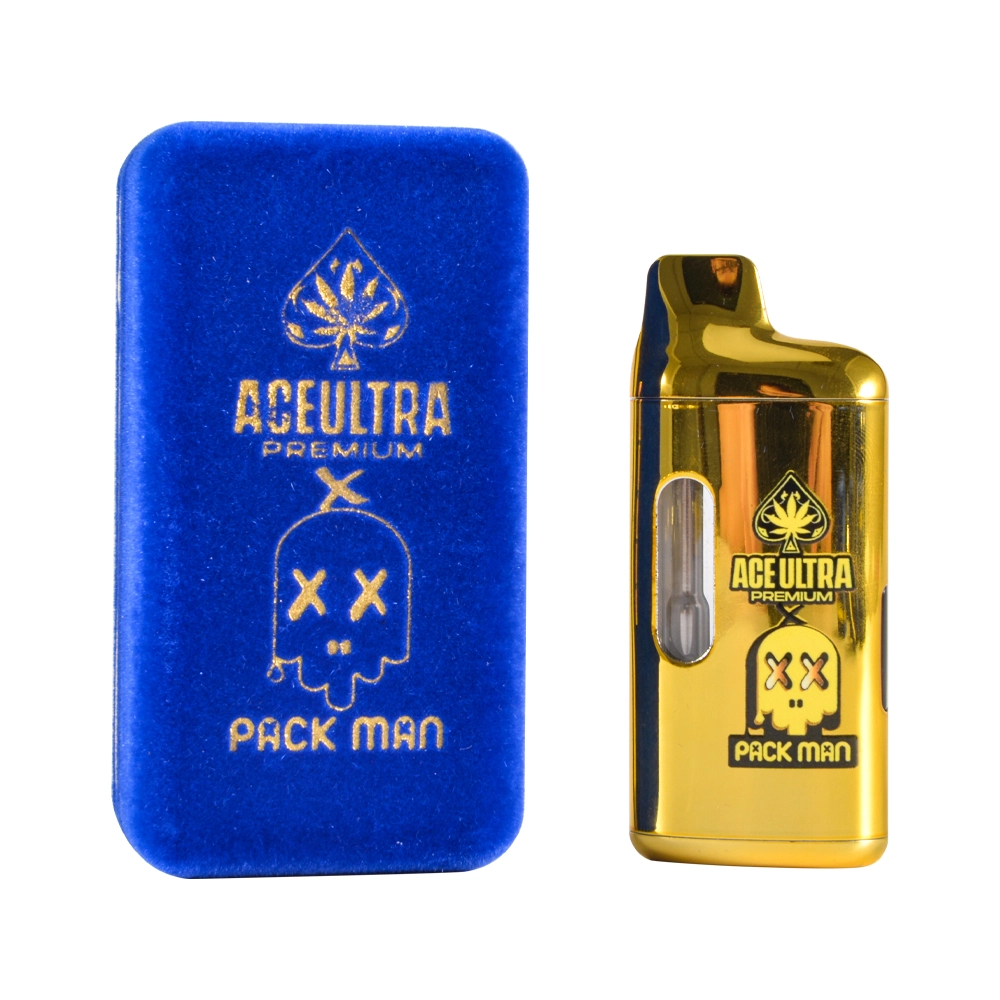
ACE PACKMAN” typically refers to a rectangular 2 g bar with a large branding surface, ceramic heating, and USB-C power. At mid-funnel, teams aren’t asking if it sells—they’re testing which variant finishes tanks cleanly and keeps returns low. Here’s the technical view that moves a project from evaluation to PO.
1) What Defines ACE PACKMAN (and Why It Converts)
-
Thick-oil intake: generous, well-placed ports and short oil paths.
-
Even ceramic heat: stable resistance band that prevents hot spots.
-
Runtime reality: cell/output tuned to reach near-empty without aggressive voltage.
-
Seal discipline: controlled gasket compression and mouthpiece torque.
-
Billboard chassis: flat planes for warnings, batch IDs/QRs, and brandwork.
These choices reduce clogs, leaks, and “dies early” complaints—the drivers of costly exchanges.
2) Spec Targets (Validate, Don’t Assume)
-
Capacity: 2.0 mL class with safe-fill mark.
-
Coil: advanced ceramic; ~1 Ω nominal for viscous matrices.
-
Airflow: smooth, medium draw; optional preheat for condensation.
-
Power: USB-C rechargeable; protections for short-circuit/over-/under-charge.
-
Finish: abrasion-resistant coating; tight color tolerance.
-
Tolerances: repeatable seal compression; minimal off-notes after thermal cycling.
3) System Behavior That Matters in the Field
A. Intake vs Viscosity
Too-small ports create back-pressure and “hard draw.” PACKMAN-class intakes should wet the ceramic quickly after cure, minimizing warm-up rituals.
B. Thermal Profile
A narrow resistance window keeps heat even, preserving terpene character and preventing carbonization.
C. Output Curve & Runtime
Voltage/current should support dense vapor without overheating; a right-sized cell prevents “half-tank death.”
D. Seal Stack Integrity
Gasket chemistry and compression must survive temperature swings and freight shocks; headspace weep should be rare.
E. Acoustic/Draw Feel
A smooth, quiet draw signals good channeling and consistent airflow—small, but correlated with fewer support tickets.
4) KPIs for Mid-Funnel Decisions (Measure These Five)
-
First-10-Puff Success – % of sampled units delivering smooth vapor without preheat tricks.
-
Post-Transit Leak Rate – leaks per 100 after heat/cold cycles and vibration/drop.
-
Runtime to Near-Empty – median charge top-ups required to finish 2 g.
-
Clog-Resolution Incidence – % of units needing any intervention week one.
-
DOA/Early Failure – activation/charge faults out of box.
PACKMAN earns the PO when it meets or beats your current device on all five.
5) PACKMAN vs Rounded Bar vs Tall Pod (Quick Compare)
| Criterion | ACE PACKMAN | Rounded Bar | Tall Pod |
|---|---|---|---|
| Thick-Oil Intake | Excellent | Very Good | Good |
| Runtime vs 2 g | Excellent | Very Good | Good |
| Branding Area | Excellent | Very Good | Good |
| Pocketability | Very Good | Excellent | Excellent |
| Leak Control (Design) | Excellent | Very Good | Good–Very Good |
If you prioritize intake, runtime, and compliance text space, PACKMAN typically wins. If ultra-slim carry is the brief, rounded/tall forms can compete—provided they hit the five KPIs.
6) Documentation & Packaging Map (Audit Speed Wins)
-
Drawings & specs (intakes, resistance, torque).
-
Filling SOP (temp, headspace, soak/cure).
-
Safety statements for device/battery; transport test summaries for the cell/pack.
-
Assembled-unit materials/heavy-metal results for oil-contact parts.
-
QC regimen with AQLs and recent lot data.
-
Packaging map with fixed zones for warnings and serialization—keeps art changes from colliding with compliance.
7) Ops Integration (Make Your Line Happy)
-
Fixture tolerances for nests and nozzles.
-
Mouthpiece torque values and gasket compression windows.
-
Guidance for preheat parameters (if supported) and late-life power behavior.
-
Color/finish tolerances to avoid shelf drift across reorders.
8) A/B Pilot Protocol (One-Week Decision)
-
Sample: 300–500 units PACKMAN vs your control device.
-
Fill & cure per vendor guidance; document first-10-puff.
-
Stress ship: heat/cold cycles + vibration/drop.
-
Track the five KPIs above across representative doors.
-
Score & decide: approve only if PACKMAN meets or beats your baseline on all KPIs; then freeze spec and set lead-time tiers.
9) 10-Point Decision Rubric (0–2 Each)
-
Intake fit • 2) Thermal evenness • 3) Runtime sufficiency • 4) Leak/DOA data • 5) Preheat utility • 6) Draw feel • 7) Docs completeness • 8) Packaging/traceability • 9) Ops compatibility • 10) Change control
Bottom line: ACE PACKMAN deserves mid-funnel advancement when engineering reality, documentation, and pilot KPIs line up. Choose the platform that wins on data—not adjectives—and scale it with locked specs and disciplined QC.
Finally, if you wanna know more details about empty vapes wholesale, could go to these pages:Ace ultra packman 1g wholesale, Ace packman wholesale, ace packman dispo in bulk,ace packman dispo 2g in bulk, Ace packman 2 grams wholesale






0 Comments