

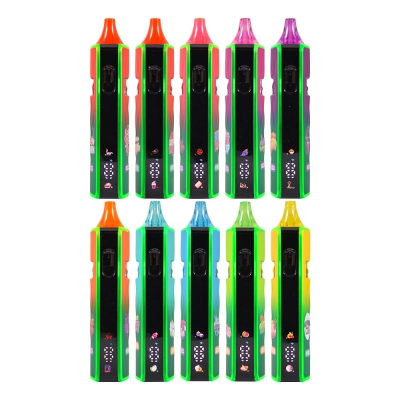
Multi-chamber devices are the new playground for empty hardware buyers. Stoned Apes 2G-style empty disposables are often dual-flavor or dual-formula shells, designed so users can switch chambers without turning the device into a muddled blend. The hidden engineering challenge is simple to state and tricky to execute: keep each side isolated when it should be, and control any “cross-bleed” so it doesn’t ruin the experience.
This article looks at that challenge from a hardware-only perspective—no oil, no THC, no nicotine. Just plastics, metals, seals, airflow paths, and how they’re arranged inside a 2g/2-chamber form factor.
Isolation vs Cross-Bleed: What Are We Talking About?
In a dual-chamber 2G shell, three design goals collide:
-
Isolation – each chamber should behave as if the other doesn’t exist when it’s off.
-
Clean switching – switching chambers should feel decisive, not mushy or random.
-
Controlled cross-bleed – any unavoidable mixing should be so small or transient that users barely notice.
For B2B buyers, isolation and cross-bleed are not just user-experience issues; they are positioning and labeling issues. If your brand promotes “two independent flavors in one device,” the internal hardware must support that promise.
Chamber Architecture: Walls, Seals, and Paths
The first question is how the two chambers are physically arranged.
Hard Separation Walls
Most Stoned Apes-style 2G devices use:
-
A central divider between two reservoirs.
-
Separate intake inlets for each core or wick.
-
Distinct channels into a shared or semi-shared chimney region.
The divider must be tall and solid enough to prevent liquid migration under normal handling. Micro-gaps, short walls, or poorly aligned weld lines are common failure points for isolation.
Seal Surfaces and Gaskets
Even with hard walls, isolation fails if the top and bottom seals are sloppy:
-
At the base, each chamber needs its own seal to prevent cross-flow through the bottom.
-
At the top, the interface between reservoir and chimney must keep flows separated until the mixing point is intentional.
Demand tight tolerances and consistent seal compression; over-compression can deform gaskets, under-compression can create hidden leak paths.
Airflow Routing: Keeping Streams in Their Lane
Air doesn’t care about your marketing copy; it follows the path of least resistance. Good Stoned Apes 2G engineering gives each chamber:
-
Its own inlet set, aligned with the corresponding core.
-
An air path that doesn’t unintentionally bypass the core and wander into the other side.
-
A clear path into the mouthpiece that only blends where you intend.
Two common strategies:
-
Separated chimneys feeding a single mouth opening. Each chimney stays independent until just before the mouth, where the flows meet.
-
Single central chimney with switching valves or ports, where only one chamber connects at a time.
In both cases, the design has to prevent “ghost pull” from the inactive side, which would cause cross-bleed.
Switching Mechanisms: How You Choose a Chamber
From a hardware point of view, switching can be handled via:
-
Mechanical sliders or toggles – physically opening one path and closing another.
-
Rotating mouthpieces or collars – aligning one set of ports at a time.
-
Internal valves actuated by external controls.
For B2B buyers, the critical questions are:
-
Does the switch fully close the inactive path, or just mostly?
-
How many cycles can it handle before wear causes partial cross-bleed?
-
Is the switch position obvious to the user, to avoid “half-on-both” confusion?
A robust device treats the switch as a critical assembly item, not a decorative gimmick.
Cross-Bleed: Where It Comes From and How to Minimize It
Some minimal mixing is almost unavoidable in dual-chamber designs, especially near the mouthpiece. The goal is to push that mixing downstream, close to the exit, and keep it symmetric and small.
Common cross-bleed sources:
-
Shared chimney sections that are too long.
-
Leaky dividers or seals that let flows mix mid-path.
-
Excessive turbulence at the transition between separate and shared sections.
Engineering tactics to reduce cross-bleed:
-
Short shared sections and longer independent sections.
-
Flow straighteners or smooth transitions that reduce turbulence.
-
Higher resistance in the inactive path when it’s “off” (even if not fully sealed).
QC and Validation for Isolation
You cannot visually inspect isolation; you have to test the device.
For empty hardware, B2B buyers can request or perform:
-
Differential pressure tests – check that the inactive chamber path has significantly higher resistance when switched off.
-
Marker tests (in controlled environments) – use innocuous indicators to confirm that paths stay separated under normal use.
Over time, production QC should watch for:
-
Wear in the switch mechanism.
-
Dimensional drift in walls and seals.
-
Any rise in customer complaints about “mixed flavors” or “not sure which side is on.”
Designing Stoned Apes 2G as a Trustworthy Dual-Chamber Shell
Dual-chamber hardware succeeds when isolation and switching feel intentional, not approximate. For B2B buyers, that means demanding:
-
Clear divider architecture.
-
Robust seals and gasket design.
-
Well-defined airflow routing.
-
Switching hardware that actually enforces “one side at a time.”
When isolation and cross-bleed are actively engineered—not left to chance—Stoned Apes 2G-style empty hardware becomes a real platform for dual-flavor or dual-formula programs, rather than a risky experiment hiding behind a cool design.
























0 Comments